
Advancing Health and Efficiency in Educational Institutions with Mars Air Curtains
Admin on September 17, 2026
By Curtis Rosol
In educational institutions, maintaining a clean and comfortable environment is essential for student success. With a constant flow of traffic and open doors, educational facilities face challenges related to temperature control, sanitation and indoor air quality.
Air curtains offer an effective solution. While they operate quietly in the background, these systems play an important role in protecting students, staff and facilities by creating an invisible barrier of air that separates indoor and outdoor environments.
One of the most common applications for air curtains in schools is at main entrances. With hundreds of people coming in and out throughout the day, indoor temperatures are difficult to maintain, especially during extreme weather.
Air curtains installed at these entryways keep conditioned air inside and prevent outside air from entering. Many air curtains are recessed into the ceiling to provide benefits without obstructing doorways or disrupting the building’s design.
School cafeterias are another critical area where air curtains provide measurable benefits. Doors to these food service areas are frequently opened, increasing the risk of temperature fluctuations and flying insect entry. Installing air curtains at dining hall entrances and kitchen receiving doors can mitigate these nuisances.
Air curtains can also support cafeteria operations through specialized dishwasher applications. Instead of installing large drying tunnels, facilities can retrofit dishwashers with air curtain systems that efficiently dry dishes while saving space and operating costs.
Many school cafeteria kitchens rely on walk-in coolers and cold storage rooms to preserve perishable foods. Traditionally, plastic strip curtains have been used to reduce temperature loss when doors are opened. However, these strips can become dirty, obstructive and difficult to maintain. Air curtains provide a more hygenic and efficient alternative that maintains internal temperatures and eliminates the need for physical strip curtains. This technology also helps prevent condensation which reduces slip hazards and improves overall safety. Maintaining consistent cold storage temperatures lowers energy costs and protects food quality.
When equipped with UV technology, air curtains can further improve food preservation. Recent studies have demonstrated that UV systems extend the shelf life of perishable goods by up to 25%. In a controlled experiment that Mars Air conducted involving walk-in coolers and produce, food stored with UV-equipped air curtains showed significantly less mold growth compared to those without the technology.
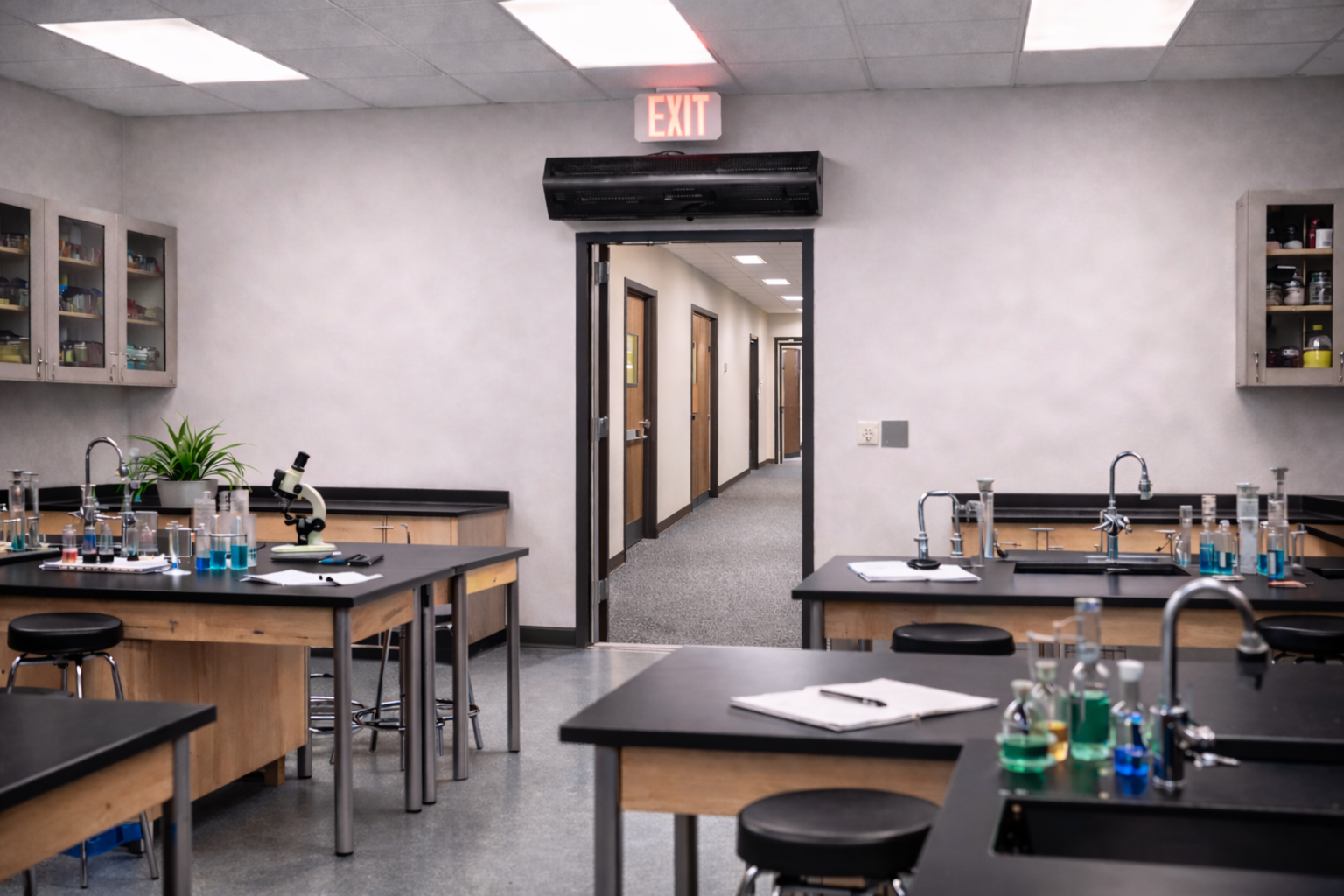
Air curtains can also be used in classrooms and specialized learning environments where cleanliness and air quality are essential. In science laboratories and clean room environments, air curtains help prevent dust, debris and insects from entering sensistive spaces. Stabilized atmospheres are essential to ensure experiments and research activities are not affected by contaminants.
Odor control and sanitation are other areas where air curtains can improve school environments.
In refuse areas, air curtains can be equipped with UV technology to help contain odors and reduce the spread of airborne pathogens. The wall of air also prevents flying insects from entering the waste area, while UV technology helps neutralize odor-causing microorganisms. Similarly, air curtains can be installed in lavatories to help control odors and maintain cleaner air in adjacent spaces.
Health is an ongoing concern in schools. When equipped with UV technology, air curtains can help neutralize airborne pathogens as air passes through the unit to reduce the spread of germs and support a healthier environment for students and staff.
Although air curtains are often invisible to the people who benefit from them, their impact on educational facilities is significant. Air curtains help schools operate more efficiently while promoting healthier learning environments. In environments where thousands of students and staff pass through each day, even small improvements in air quality, sanitation and temperature control can make a meaningful difference. Air curtains may work quietly behind the scenes, but their benefits are felt throughout the entire campus.
Mars Air System hosted a webinar on this topic. You can watch it and learn more here: Webinar Replay